
Endowment, Quasi-Endowment, Custodial & Trust Accounts
by Susan Cothern, Director of Development Ministry, United Methodist Foundation of Louisiana
Churches often use terms such as “endowment,” “quasi-endowment,” “investment fund” and “charitable trust” interchangeably. But while these accounts may all involve invested assets, they are not the same — and the differences matter. Each term carries distinct legal, accounting and governance implications. Understanding what each one means can help churches honor donor intent, manage funds appropriately and avoid potential audit or compliance issues.
Here are the terms most often used interchangeably in churches and a simple explanation:
· Endowment – A donor said, “Never touch the principal.”
· Quasi-Endowment – The board chose to act like a donor said, “Never touch the principal,” but can use principal if it collectively decides to. Promotions of endowment/quasi-endowment should be clear to donors.
· A Custodial Account / An Investment Fund – It is church’s money that is invested, but not endowed.
· Charitable Trust Account – A legal entity with its own EIN and a legal document that controls everything.
Comparison at a Glance:
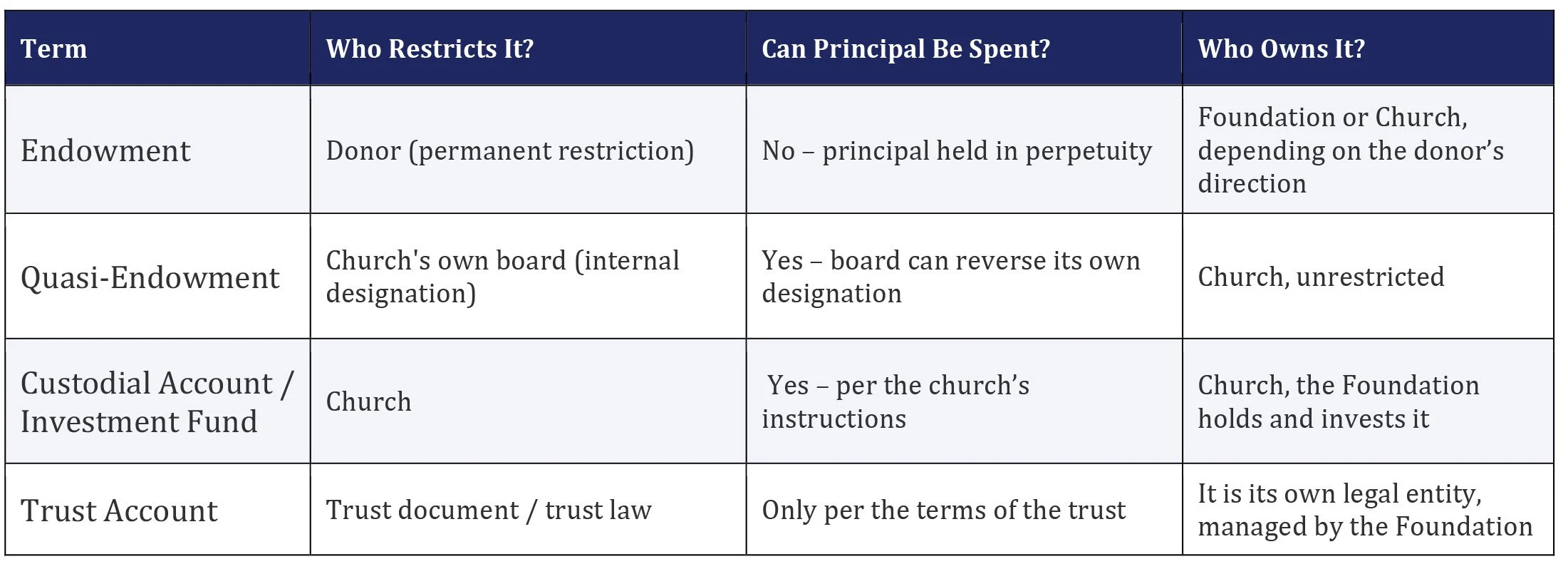
Definitions:
Endowment (True/Permanent Endowment): A donor-restricted fund in which the donor stipulates, as a condition of the gift, that the principal be maintained in perpetuity (or for a stated term), with only income or a prudent spending-rate portion available for use.
Quasi-Endowment (Board-Designated Endowment): Funds the church's own governing board voluntarily sets aside and manages like an endowment. Because the restriction is internal, it is not donor-imposed and the board retains authority to utilize principal/corpus in addition to earnings.
Custodial Account (Investment Fund): An account where the Foundation holds and invests the funds on behalf of the Church who retains ownership and control, and determines the investment allocation.
Trust Account: A formal legal arrangement in which assets are held by a trustee under a trust instrument and administered for named beneficiaries or purposes under fiduciary duties defined by trust law – governed by a separate legal document rather than ordinary gift restrictions.
Using the correct terminology is more than a matter of semantics — it helps churches understand who controls the funds, what restrictions apply and how those assets can be used, protecting both the church and the intentions of those who provide its financial resources.
Note: These are general definitions for training purposes. Most states govern endowment funds through UPMIFA (Uniform Prudent Management of Institutional Funds Act). Consult a qualified attorney or CPA before finalizing gift acceptance, spending, or fund-accounting policies.